Sunday, 6 August 2017

C&C Napoleonics - Gamonal 10th November 1808.

For my second battle using the Spanish expansion, I have chosen Gamonal, which occurred just ten days after the previous battle featured on this blog. The Pico River is fordable along its entire length. Just a village and small town on the map, no hills and some forest.


The terrain laid out on the board, not too much to negotiate and ideal for cavalry.


The troops deployed. The French left wing consists of three units of dragoons, two of hussars and a single horse battery. The rest of the line being line, lights and a single unit of milita, plus two foot batteries. The Spanish have two units of light and one of heavy cavalry, on their right flank, with a single unit of light cavalry stationed behind the town of Vellimar on the left flank. The remainder are a mixture of foot artillery, line, grenadiers and a single militia unit.


The Spanish commander at Burgos, Conde de Belveder, was an inexperienced and rash officer. He had moved out of the strong defences of Burgos into an open plain well in front of Gamanol.
Soult and his advance guard arrived, and seeing the enemy's weak position, immediately launched an attack.

As the Spanish commander my options are pretty limited. The bulk of my cavalry on the right flank will need to be steadfast to prevent that flank being rolled up by the French. I will have to make the most of the forest terrain, in the hope of slowing down the enemy in the centre and my left.

As the French commander, I am licking my lips. Just as Soult did, cards willing, I shall launch my mobile left flank at the Spanish cavalry, destroy them and turn on the now vulnerable Spanish line. In the centre and right, I will advance enough to engage with artillery, use the forest to cover the advance of my infantry and await the cavalry to do their work.

This is a six victory banner game and the Spanish begin with one Guerrilla token.


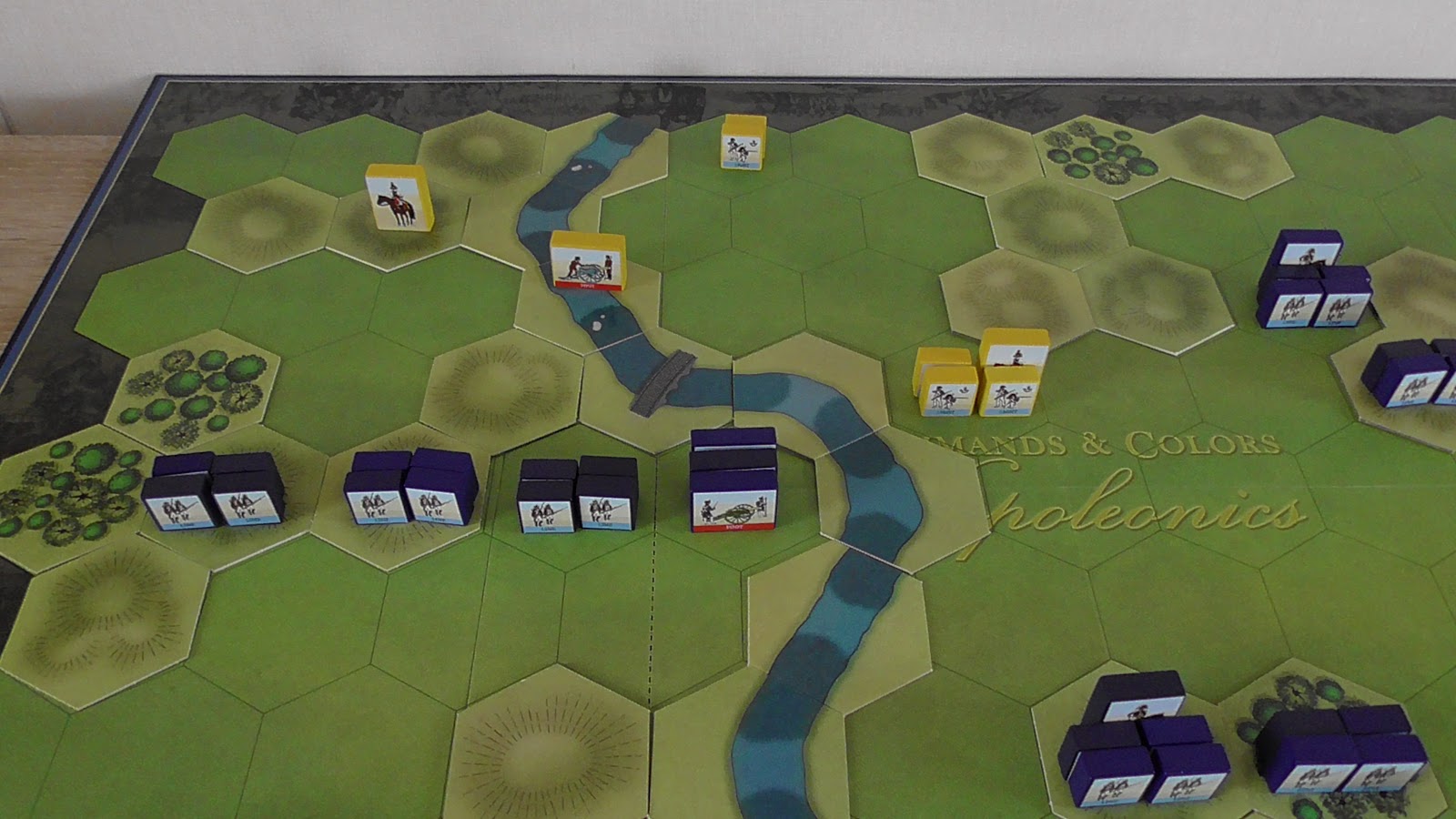
End of Turn Two. The French heavy cavalry advance on the left flank, General Milhaud attaches himself to one of the units. In the centre, the Horse Artillery advances and fires ineffectively at the Spanish Grenadiers. The French lights advance through the forest towards the advancing Spanish line.


Milhaud and his two units of dragoons threaten on the left, whilst the lights and horse artillery advance. A Spanish line has also entered the forest.


On the Spanish left, the militia move into the town of Vellimar as the light cavalry move up.


End of Turn Three. The French lights in both forests are very successful against line regiments, in the centre losing two blocks and being forced out of the forest. In the right forest, the lights almost destroy the Spanish line facing them. On the Spanish left the light cavalry charge the foot artillery and force them back, but the other foot artillery push back a unit of French line.


The battle in the left forest.


The lights are also successful in the right forest.


Spanish casualties.


French foot artillery and line pushed back.


End of Turn Four. The French horse artillery cause a casualty to the Spanish Grenadiers, the lights in the left forest advance and battle, pushing the Spanish line back two hexes to the base line. However, the Spaniards are not sitting idle and awaiting the French to form up their cavalry for a mass assault, instead they play Cavalry Charge and units on both flanks thunder forward.


The target of the light cavalry on the French right, hastily form square and are able to roll a flag to push the attackers back.


It does cost a card.


On the French left, the Spanish charge is successful, one unit loses a block and is forced to retreat, The unit containing Milhaud loses two blocks and only his presence, prevents them retreating, They are in such a disarray, they fail to hit on the battle back.


The first French casualties.


The Spanish line who had been in melee with the French lights fall back two hexes.


Spanish casualties.


End of Turn Five. The French cavalry on the left flank are rallied by their general and charge the Spanish light cavalry, one unit is completely decimated whilst the second suffers a loss and falls back. A third French heavy cavalry unit also crosses the Pico River. Better luck for the Spaniards on the other flank, they now have two infantry units in square, but do take a hit themselves.


Death by the river!


The first victory banner goes to the French.


Two infantry units tied down, but at a cost, the light cavalry lose one block.


The Spanish foot artillery unleash a salvo into the forest, and remove a block of French lights.


The French casualties so far.


The two lost cards are going to present problems for the French general.


End of Turn Six. The French light cavalry advance in the centre, as the Spanish light cavalry by the river fall back. The single block of infantry in the forest also fall back. The French lights are pushed back in the left forest and finally the Spanish foot artillery, score a hit on the advancing light cavalry.


The light cavalry, with general attached advance in the centre, but are hit by artillery fire.


The lights in the forest are pushed back.


End of Turn Seven. The heavy cavalry on the left flank advance. The French lights in the right forest are pummeled and the Spanish light cavalry try to break one of the French squares, both suffer a loss.


Finally, a card to enable the heavy cavalry to continue their advance on the flank.


The lights in the forest are taking a lot of punishment.


The square and light cavalry continue to duel.


Spanish losses.


French losses.


End of Turn Eight. The French lights in the right forest are finally defeated, a victory banner for the Spanish. However, the French respond with the light infantry in the wood closest the weakened Spanish light cavalry, unleash a volley which wipes them out. A French victory banner.


All the action in this area of the field.


It allows one line unit to abandon square, the offending enemy light cavalry having been destroyed.


Getting a card back in the process.


The French are now on two victory banners.


The Spanish have one victory banner, but are chipping away at the French.


End of Turn Nine.


The French dragoons make their move, one unit attacking the light cavalry which they destroy in melee for a victory banner. The Spanish heavy cavalry advance into the river to charge the dragoons, they cause a casualty, but in the battle back, are wiped out, for another French victory banner.


All of the Spanish cavalry are now destroyed, the Spanish line is now at the mercy of the enemy cavalry on their right flank.


Most of the French cavalry have casualties, but they are still a potent fighting force.


End of Turn Ten. As one unit of dragoons crosses the river, another charges the weakened Grenadier unit and totally destroys it for the fifth victory banner. The horse artillery opens up on a line unit and causes two casualties. the last French square is able to reform and the card is returned.


Scene of the cavalry charge and artillery fire. The Spanish general advances a line regiment forward and attached himself to it.


The last square marker is removed.


Things do not look good for the Spaniards, the enemy to the front and flank.


Five victory banners.


Very little to show for the Spanish effort.


End of Turn Eleven. A La Grande Manoeuvre card allows the French right flank to advance. The militia in the town, score a hit and push one of the line units back. The Spanish line unit beside the town also throws back a French line unit with a casualty for good measure.


The French taking casualties.


Plenty of casualties, but very spread out, the next victory banner seems as far away as ever.


End of Turn Twelve. French dragoons charge and destroy a weakened line unit. Game over as the French take the sixth and final victory banner.


The victorious dragoons, run amok on the flank.


Six victory banners.


Just a single banner for the Spaniards.


Another very enjoyable game. As the French player the cards finally arrived to carry out my cavalry assault, a little later than planned, but very effective when it did get going. As the Spanish general, the cards were not very kind, I decided to use my cavalry on both flanks in a bold move, rather than just sit and wait for the French to hit me. It had some success tying up two units in square, but the gamble by the river, initially successful with the charge impetus of the card, was doomed once the heavy dragoons recovered.

For the final test battle of this expansion, I am eyeing an all cavalry affair. Dragoons and Hussars on both sides in pretty equal numbers. It should be interesting.


Thursday, 3 August 2017

C&C Napoleonics - Zornoza, 31st October 1808

After fighting three battles from the core set of Commands & Colors Napoleonics, one described in an earlier blog post, and two on my You Tube channel, I am moving onto the Spanish Army expansion. I am still using the rules and cards from the base set.

The Spanish army does have an ability to use the Spanish Guerrilla Action. Some scenarios give the Spanish player one or more tokens at the start of the scenario, or none at all. However, when playing a Scout card, he can opt to take a Guerrilla Action token, as opposed to drawing two cards, selecting one, and discarding the other. He simply draws one card and a token.

The tokens are used in an attempt to nullify the French player's command card on any French turn. Once the French player reveals his card, a token can be played. The French player then roles a single die and can stop the Guerrilla Action by rolling a sabre icon. Any other result and the card is discarded and the turn passes to the Spanish player.

Playing solo, means of course, that I know the cards in both hands. Willingly or not, I know which is the best card in the French hand, and so could use the token when it is played. Not very satisfactory. I have come up with a house rule, that allows the Spanish player to effectively have two turns, one after the other, without the French player losing his command card. After the Spanish have moved/fired etc. the token can be played to give them another turn. The token is then discarded.


The scenario chosen is the second in the book. The French army launched a three pronged attack on what was deemed to be a vulnerable Spanish force. The Spanish centre disintegrated and the two wings were forced to retire and cover the centre. The Spanish commander successfully carried out a swift retreat in good order.

A special rule for this scenario, to reflect the retreat, is once three ordered units have retreated off the Spanish side of the board, every ordered unit after those, is worth a victory banner. Units forced back due to combat leaving the table, do not count as a banner.


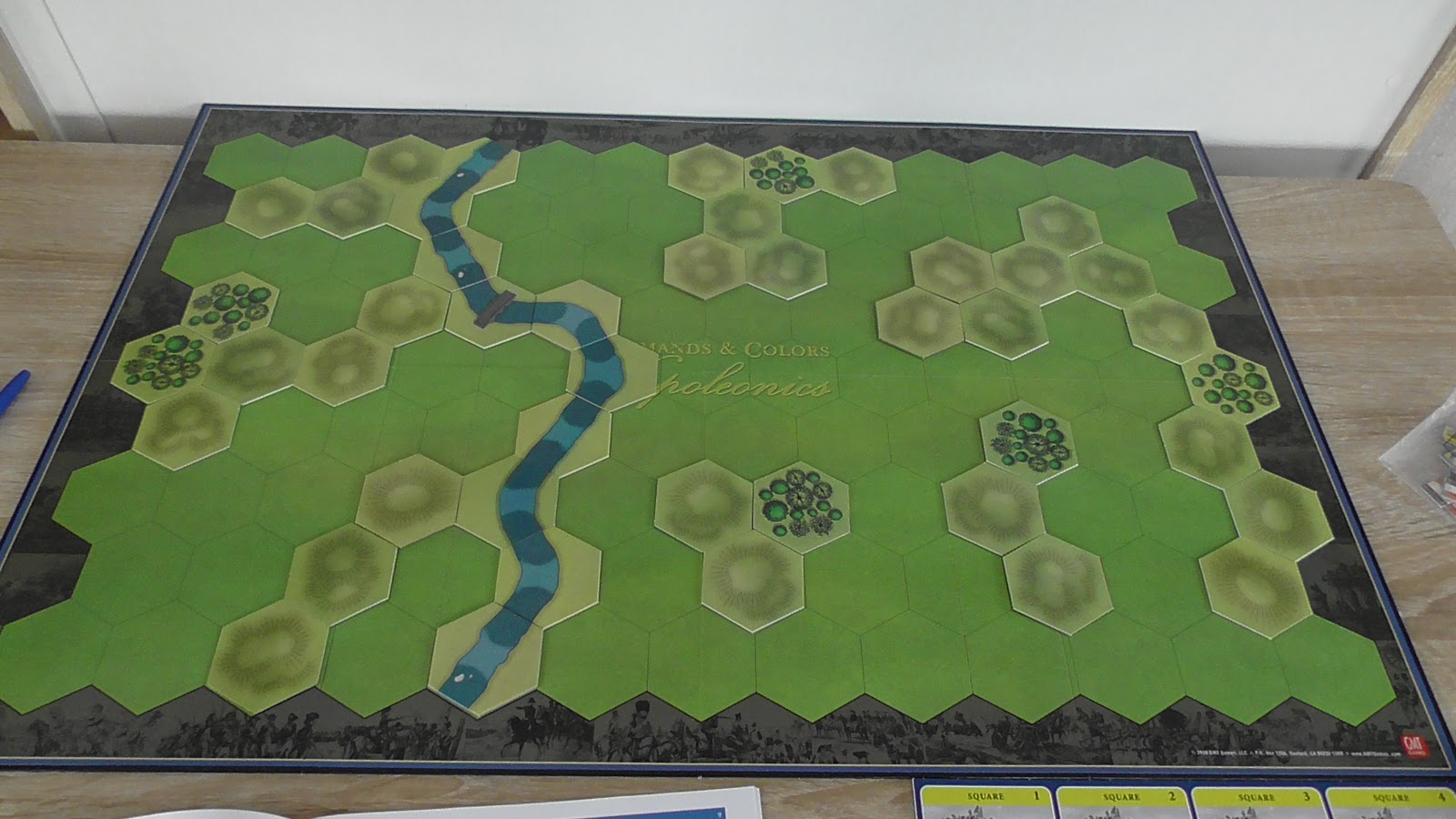
The map recreated on the game board. The river is fordable along its entire length. Lots of hills and a few woods dotted about.


Both sides troops deployed. No cavalry for either side in this scenario. The French infantry are exclusively line, whilst the Spanish have two units of Grenadiers and three of light infantry, mixed with their line units. The Spanish have one Foot Battery to the French two Foot Batteries. The French move first.

As the French player, I really need to advance my troops and get them into action as quickly as possible to gain the six victory banners required to win the game, before the Spanish troops can withdraw off the table.

As the Spanish player, I will have to sacrifice a number of units to fight a rearguard action, allowing the remainder to exit off the table.

Well that is the plans...

I won't show a die roll by die roll, but will give a commentary of what has happened in each turn.


Positions after the end of Turn Two. The French right flank advanced and attacked causing casualties on the Spanish units attempting to withdraw. In the centre, two Spanish units plus a general exited the table.


The French right flank rush forward.


With all efforts concentrated on the right flank, the French could only stand and watch as Spanish units opposite, began to withdraw.


The Spanish flank is already opening up a gap to the French.


The Spanish have retreated two units plus a general off the board. Once three ordered units have left the board, each unit after is worth a victory banner to the Spanish.


Spanish casualties on their left flank, the French have to destroy units quickly, before they can exit the board and escape.


Due to cards rather than choice, the French right once again attacked, wiping out a line regiment for a victory banner and causing hits and unfortunately, retreats to the Spanish. The Spanish right flank was able to continue its withdrawal without enemy interference.


All the fighting is on this flank, or at least by the French, the Spanish simply melt away from combat.


End of Turn Four. A bayonet charge by the French causes huge casualties and gains a second victory banner.


End of Turn Five. With all opposition on French right flank having either been destroyed or retreated off the table, a La Grand Manoeuvre card is played and the French left flank hurries forward to engage the fleeing Spaniards. They move four hexes, but cannot battle this turn.


The French right has done its job and now needs to block the line of retreat of centrally placed Spanish units if possible.


The Spanish continue to fall back, rather than fight.


Some Spanish units are now becoming trapped in the centre, if only the French had a centre card!


The Spanish units exiting the board, now begin to pick up victory banners.


The French on the left engage the enemy with artillery and musketry, they cause hits, but more worryingly, also cause retreats.


The Spanish may be abandoning the field, but they are paying a horrendous cost in casualties, as the French move up to three victory banners.


The Spaniards in the centre have been abandoned to their fate.


The French are desperate to get to grips with the fleeing enemy.


The Spanish remain on one victory banner, but a number of units are very close to exiting the board.


The French have three victory banners, half way to a win.


End of Turn Seven. The French right flank begin to advance towards the centre in an attempt to cut off fleeing Spanish units. The Spanish use an attack centre card to retreat a line unit off the board for a victory banner, and use to the other actions to engage a French line unit, scoring two hits and forcing it to fall back.


With no enemy before them, the French right flank begin to move toward the centre.


Spanish light and line infantry engage a unit of French line, causing casualties and forcing them back.


The Spanish managed to order another unit off the board for a second victory banner.


Turn Eight. The French right again advanced and led by General Leval, they destroyed a weakened Spanish unit in melee. The Spanish continue to fall back on their right flank.


Four victory banners now for the French, they are also in a position now to cut off the central Spanish units.


Two more Spanish units very close to exiting the board for victory banners.


The French right continue to move behind the Spanish centre, but also pull back the weakened line regiment, not wanting to risk an easy victory banner for the Spanish.


General Rey must be a worried man as he observes French infantry in the hills to his rear left.


The Spaniards continue to retreat, one unit of line off the board for another victory point and the lights fall back a hex.


The Spaniards now reach the halfway point in victory banners.


Finally, the French have a card to activate the centre. General Sebastiani advances with three infantry brigades, even with half dice, they cause casualties to both Spanish units before them.


The Spanish centre in a dire predicament.


Spanish General Mendizabal, sees it prudent to pull back onto the ridge line, for observation purposes of course!


The French play a flank attack card, with musketry they destroy the Spanish light infantry and claim a victory banner. On the left flank the infantry score two hits on the Spanish foot artillery.


The Spanish manage to retreat a grenadier unit off the board, as the remains of a light unit fall back to the board edge.


Four victory banners, with another pending. Will it be in time?


The French on five victory banners, are just one banner a away from the win.


Turn Twelve. Game over. A centre probe card allowed the French to engage the last surviving Spanish light infantry unit in the centre, a combination of musketry and artillery fire, gained the sixth and final victory banner for the French.


General Rey survived the carnage.


The Spanish were still at least two cards away from evacuating the two units they required for a victory.


The Spaniards took huge losses.


They saved part of the army, but at a high cost.


A French victory in the end, a very enjoyable scenario that I will tackle again in the future. Next time I think the Spaniards need to make a stand with the majority of their army, maybe claiming two or three banners via the retreat off the board, and taking three or more banners by destroying French units. The French had to advance into action quickly, which they were able to do on both flanks, but the centre was rooted to its starting positions for most of the game. Fate is determined by the fall of the cards, incidentally, the Spanish didn't draw a single scout card, which would have enabled them to receive a Guerrilla token.

Next up will be a battle fought just ten days after this one, Gamanol 10th November 1808.