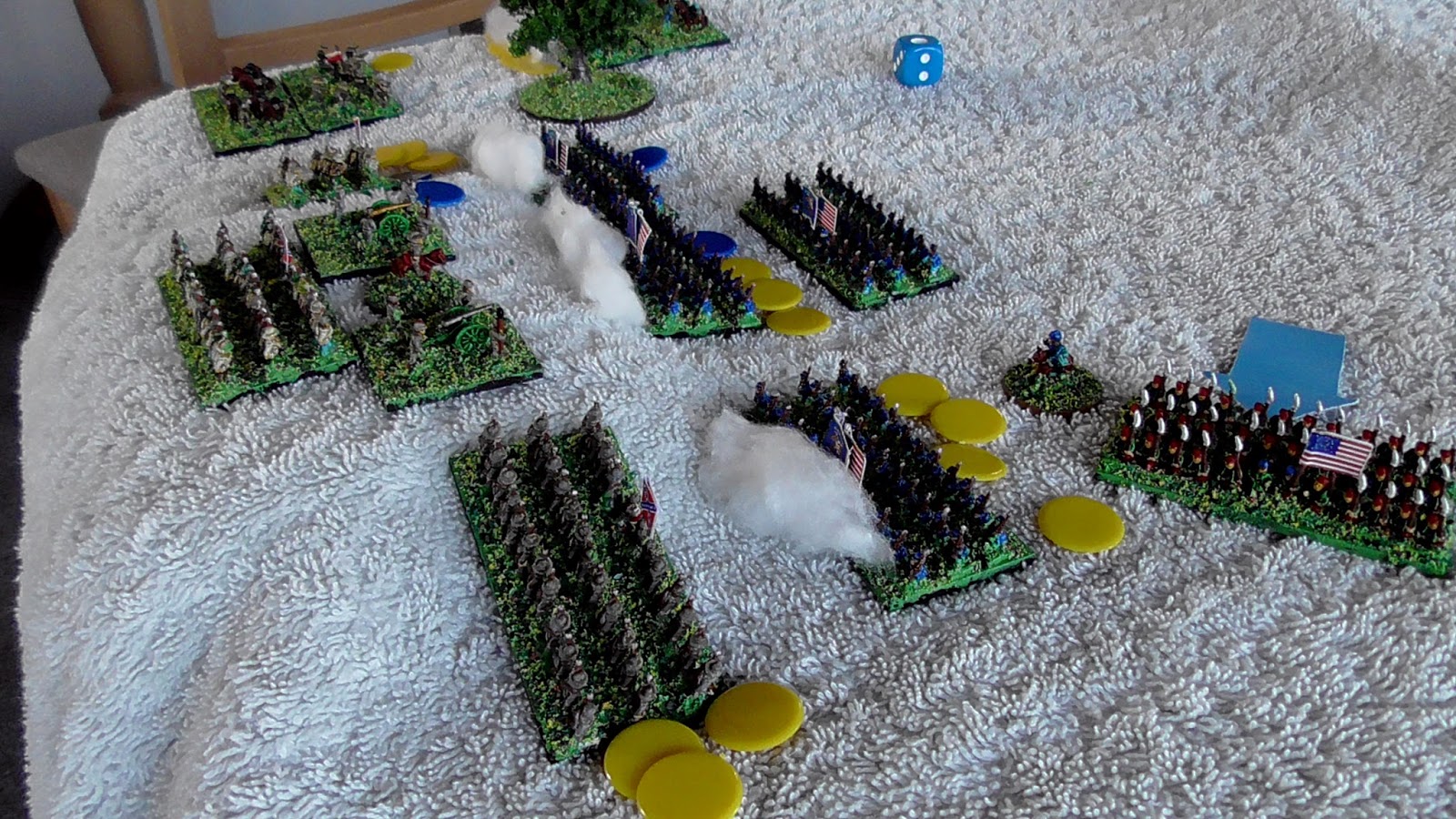
Sunday, 20 November 2016

OHW - The Campaign - Part Two

Brigadier General Frank Frey, Confederate divisional commander, screwed up his eyes as he scanned the enemy before him. He watched as horse teams struggled to pull their cannon up the hill opposite. That piece of high ground, along with the crossroads his own troops currently held, would be the key to this part of the battle. He knew on his left flank, Bear would do all he could to throw the Yankee's back.

The pain shot through his feet as he adjusted his position in the saddle, Dale Norbeck grimaced and tried to ignore the pain. He too was watching the enemy deploy and immediately saw that they had set up two batteries in good positions for both attack and defence. He would have to take those crossroads, and at the same time hold this small hill.


Scenario Two will be a continuation or rather an extension of Scenario One. We have already seen Brown's Brigade triumph and push Bear Moulden's brigade back. This is the other brigade in each armies division. Although the scenario says no reinforcements available, Two units of infantry, one of them Zouaves, led by General Brown had started to head East on the Union turn nine. So if this battle is still raging by Union Turn 10, those reinforcements will indeed arrive on the table.


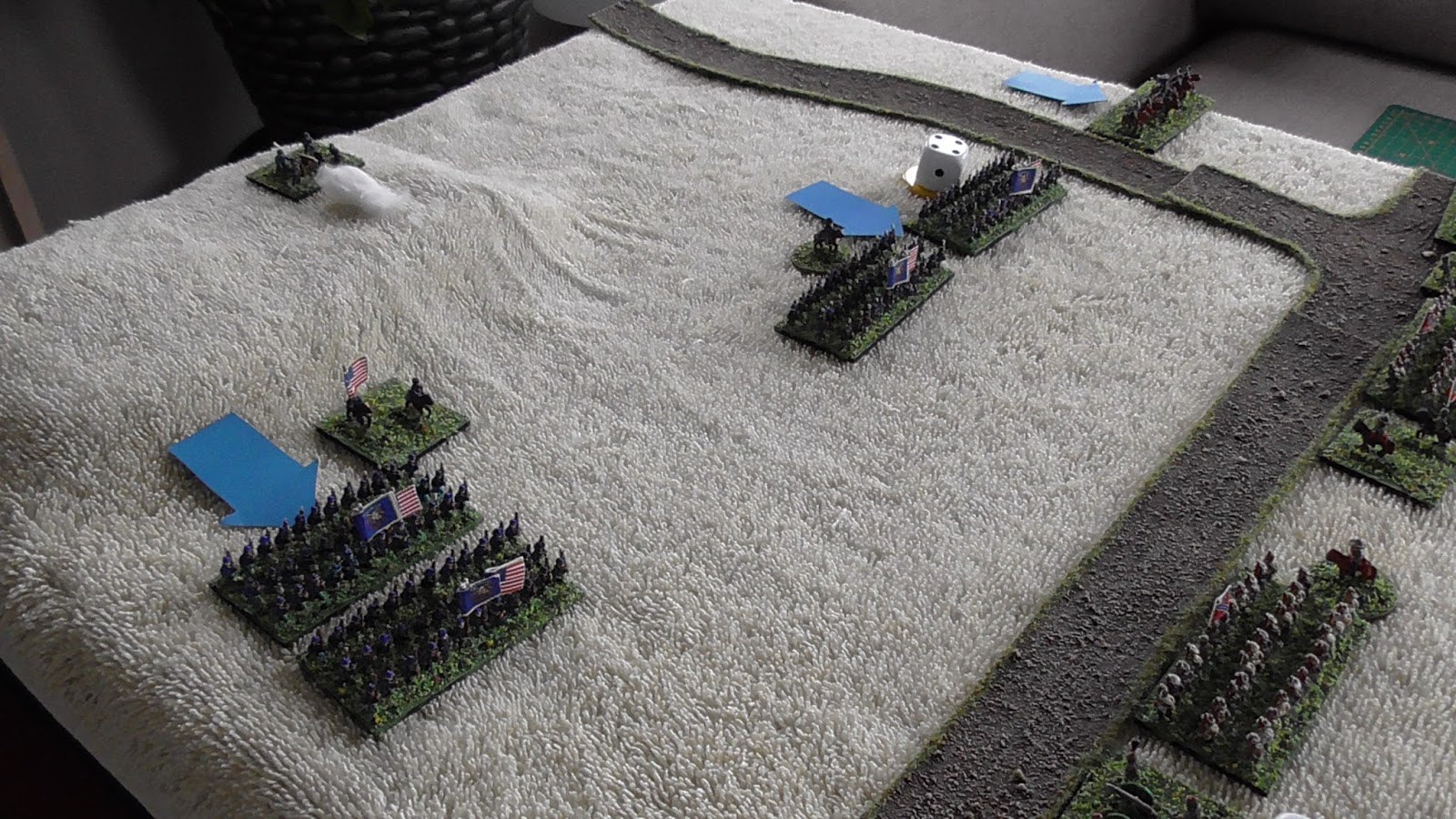
The battlefield map. The objective is to occupy both the hill and the crossroads to win the scenario.


A roll of the dice, gave the Confederates exactly the same make up of force as in Scenario One.


The Union rolled a 1 and so exchanged a unit of Zouaves for an artillery battery. Both sides have a regiment of cavalry.


The field laid out ready for battle, the ground should be light green, though it doesn't show up in the photographs.
 

Eye level view from the crossroads to the hill.


Union deployment, cavalry on the left, artillery on the hill.


Brigadier General Norbeck looked along his line, he would advance on the enemy, but only after the artillery battery had got off a couple of salvos, hopefully they could do something about the enemy guns. He disliked sending his men across open ground into the mouths of cannon.


The men of the left flank would have no such luxury, they would have to face a storm of iron if they wanted to take the crossroads.


Brigadier General Frey, had the self same problem, he knew his boys would have to take that hill defended by an artillery battery. He had split up his own batteries, one defending the crossroads and the other ready to support an attack, or indeed defend against one.


Looking along the Reb line.


Frank glassing his foe.

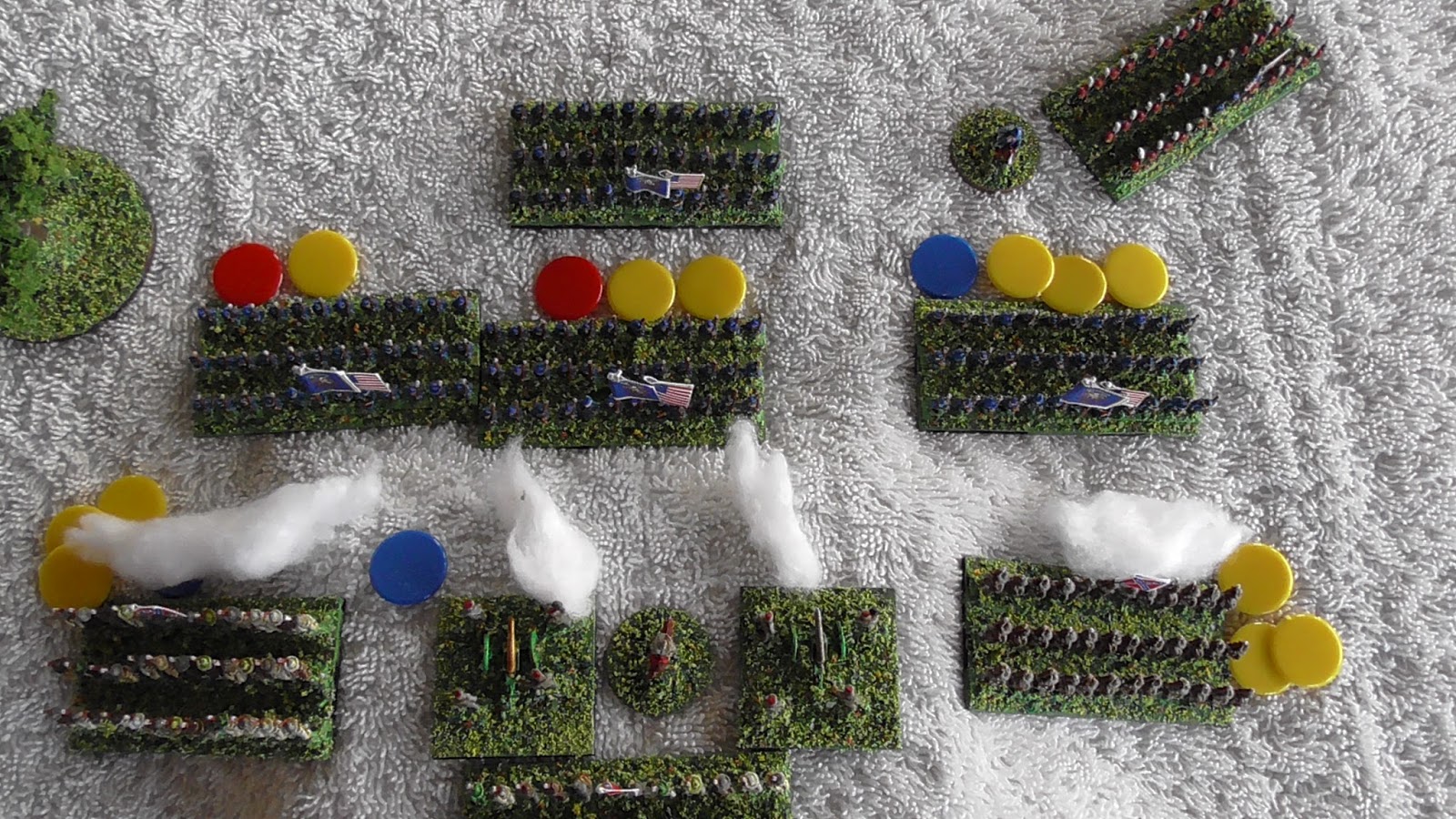
I had intended to use micro dice on coloured plastic discs of varying colours to show hits taken by units. But of course, search as I might, I cannot find them, so it will have to be normal sized dice.

A brief explanation, each unit can take 15 hits before it is removed from the table, so hits 1 - 5, will sit on a yellow disc, 6 - 10 blue, and finally 11 - 15 on a red disc.


The Union battery opened up, it was also the pre-arranged signal for General Brown on the right flank to begin his attack.


The balls landed among the Rebel cannon, causing death and destruction as they bounced and ricochet through the battery.


The shaken gunners rushed to return fire.


But, maybe due to what they had just experienced, their shots failed to score on their opposite number.


The other battery, more composed let rip on the advancing infantry.


Balls finding their mark.


Still on counter battery fire, the Union guns opened up once again.


Again they put heavy fire down on the Confederate battery causing more hits, the disc being blue indicates a total of 7 hits.


At this point, General Norbeck ordered the right flank to advance off the hill in column.


 'The drums started a beating and the officers began hollering. Our regiment moved forward and down the slope of the hill. Another regiment followed along behind us. The cannon were booming, ours and theirs, but none of it seemed to be coming our way.'

Private Gavin Booth, Norbeck's Division.


'Hold steady lads!' Sergeant Bob Smith walked up and down behind his company of infantrymen. 'Them blue bellies are sure as hell getting a hot time from our big guns,' he stopped and winked at a nervous looking young man, or should that be boy? His eyes wide with fear.
Bob smiled. 'Why there won't be any of them thar Yankees left for us to kill at this rate.' It caused a ripple of nervous laughter along the men and even the boy smiled.' 
Right on cue, the guns fired again!


For a third time, the counter battery fire had no effect.


Whilst close to Bob Smith's boys, the battery did another point of damage to the Union Infantry before it.


Once more the Union battery hits the enemy cannon, now pushing it to 11 hits.


Red disc plus a 1 = 11 hits.


The lines of blue continue to advance across the field.

Giving up on counter battery fire, the Rebel battery turns its guns on the approaching infantry. They score only a single hit!


Men are falling dead and wounded, but not as many as should have.


The other Reb battery engaged the oncoming cavalry, and missed with the lot.


The Union battery on this occasion failed to score a hit.


Some respite for the gun crews.


The Union line now moved into musket range and braced themselves.

'Cannon balls landed among us, and men were blown away, or left with hideous wounds. A man's arm, still clutching a musket landed on the grass not two paces from me. Now those damn Rebs are taking aim with their muskets.

Private Gavin Booth, Norbeck's Division.


On the Union left flank, the cavalry dismounted and prepared for action.


Combined musket and artillery fire should have blown away the leading Union regiment, but the poor confederate shooting just continued on this flank, Private Booth had no idea how lucky he and his buddies had just been.


The awful confederate marksmanship continued on the other flank, when again the combined fire of and infantry regiment and artillery scored just a single hit.

'Reload, reload! shouted Bob Smith, 'What the hell are you shooting at, them Yankees is on the ground, not flying! Keep your barrels down, remember your training.'


The Reb cavalry too dismounted to face the enemy.


The Union artillery select the only target now open to them, and score three hits on the infantry regiment in the centre of the Confederate line.


Musket balls fly and and men drop out of line.


In the centre, neither of the infantry regiments, Union or Confederate, are within musket range.


The dismounted cavalry conduct their own battle on the flank.


Artillery and musket fire rip into the regiment containing Private Booth, they take horrendous casualties.


The central infantry division, wheels and moves into musket range of the Union centre.


On this flank too, the Confederate shooting finally comes good and a second Union infantry regiment is devastated and close to breaking.


The Reb cavalry have no so such luck.


General Norbeck stands on his stirrups, ignoring the searing pain in the soles of his feet. Looking along the line he can see his units taking a terrible punishment, He senses the enemy may be close to breaking and just hopes his boys can carry on fighting a little longer.


The endless crackle of muskets and boom of cannon continues, and men continue to fall dead or wounded.


In an instant, the picture changes, another accurate volley of musket and cannon, destroy the leading infantry regiment.


At the same time the left most flank infantry regiment is also hit by the same combination of arms, it too is destroyed, the survivors running or limping to the rear.


Frank sees the two Union infantry regiments rout, looking at his own battered command he wonders if it is enough.


Even the Reb cavalry find their shooting starting to pay off, with a hit.

 Just like all good serials, I will end this part here.

Can Frank's Division hold on?
Will the Union line recover?
What happened to Private Booth?

All these questions will be answered in the next post.

 You may remember Private James Boyle in Scenario One, well the real James was kind enough to supply a letter written by his ancestor, I enclose it here.

 "Dearest Mother,

I have received your latest letter and I must say it warms my heart to read your words. We have just returned to camp after a terrible fight, and I must say that I am quite surprised to find myself in one piece. It was a most terrible affair, and it would seem that the whole of the Confederate army was shooting at us. We were able to drive the Secesh off the hill and it was a most joyous sight to see them running. Joe got hit pretty early in our march up the hill. It wasn't until after our fight was over that I found him. He was a right dreadful mess and I would guess that it was the rebel cannon that had killed him. The watch in the package was his. I know Lucy will be saddened by the news, but maybe having his watch will help cheer her up. I must bring this letter to a close. Fear not Mother, for I am safe.

Your loving son,

James"


Saturday, 19 November 2016

OHW Campaign - Thoughts, suggestions & theories.

I am shortly to commence the second scenario in the One Hour Wargames book, and would like to thank everyone who has commented, either on the blog, or the sites on which I posted links. Your thoughts and comments are much appreciated.

The first scenario went very well, I enjoyed creating the narrative that ran alongside it, and was especially pleased when the real James Boyle, wrote a letter to his mother about the battle, putting himself in the footsteps of his ancestor. I intend to include it in part two of the campaign. The second scenario is linked to the first one, in as much as the remaining brigade of each division, is engaged there, we already know the outcome of the fight between Brown's and Moulden's Brigades, but as yet do not know what happened just to the East.

I am not totally happy with the way I am marking casualties, it involves using lots of coloured, plastic discs. They do show the current state of each unit clearly to the viewer/reader, but do look rather unsightly.

There are a number of alternatives which I can experiment with. As there are only a maximum of six units per side in these rules. Each could be numbered in some way, and a simple tally chart, old school style, kept off the table and out of view, to record the current casualties. However, as this game is being played with the reader in mind, they would have no visual sign as to how each unit was performing.

A second option, and one that I shall implement in the next battle, is to use a single disc, with a micro dice on top. So a yellow disc with a micro dice would indicate its losses from 1 -5, then a blue disc 6 - 10, and finally a red disc 11 - 14. On 15, the unit is of course destroyed and removed from the table.

A third, and more radical idea, would be to reduce each units hit points down from 15 to 5, and each unit that fires, rolls two dice, 4, 5 and 6 counting as hits, adjusted for cover, elite etc. It would of course still need some sort of visual reminder placed with the unit.

The game itself was fast and furious, exactly as the author of the rules intended, I thoroughly enjoyed playing out the battle, but of course it took a good deal longer than an hour, due to me, stopping to photograph and write up the next part of the narrative. Simply playing out the scenario would have certainly taken a good deal less than 60 minutes.

Another couple of things I learnt from this was firstly, Minie ball as opposed to Mini ball, as I wrote it in the narrative. The ball was named after its inventor, who also designed a rifle too. Secondly, the hand towel I used as a cloth, although originally pale green in colour, has over time faded to look almost white in the photographs, a couple of readers thought I was simulating snow. So a darker towel will need to be found.

Onward to the next battle!

Thursday, 17 November 2016

OHW - The Campaign - Part One

As the clouds of war gathered, the states began to fragment, each deciding on the road they would take. North or South, It would impact on the lives of every soul in this fledgling nation, not yet quite a century old.

For Colonel Neil 'Bear' Moulden, a cavalry commander, based out West, it had been a bitter choice, he had been wearing the blue uniform of his nation for more than a dozen years, working his way up to his present rank, protecting the ever spreading settlers from native attacks.

When the split came, Colonel Moulden and almost a third of the troops who served under him, left the fort to journey back to their homes in the southern states. Bear had resigned his commission and on that last night at the fort, had raised a glass or three, with men who would now be the enemy. On arriving home, he had offered his services to the Confederacy. Experienced officers were in short supply and he was immediately appointed as commander of a mixed brigade, with the rank of Brigadier General. His brigade would be part of the division commanded by Brigadier General Frank Frey, a decorated old war horse who had distinguished himself in the Mexican War.

That division had just been ordered North to counter a reported incursion across the Potomac by a small Union force...

Riding at the head of his brigade, 30 year old Brigadier General Kurtus Brown cut a fine dash. Of medium height and build, sitting astride his stallion Walter, looking every inch the brave warrior. The son of prosperous Pennsylvania family, he could have followed his father into a career in law, but Kurtus' blood pulsed with the genes of his German descendants, West Point had been his ultimate destination since boyhood. A student of history, he carried a, creased and battered, portrait of the young Napoleon Bonaparte in his saddle bags.

He excelled at the military college, and graduated in the top three of his class, serving initially as a second lieutenant with an infantry regiment. His card was marked, and soon he served in both the artillery and the cavalry, giving him a taste of all arms of the service. With each new posting had come a promotion, so by the time war broke out, he too had been promoted to Brigadier General. His command along with a second brigade, are part of the division commanded by Brigadier General Dale Norbeck, another veteran of the Mexican War.

Bear and Kurtus, along with the men they commanded, were now on a collision course...

A dust covered courier arrived from the East, Kurtus took and read the dispatch. General Norbeck with the Second Division had run into rebel troops, scouts and pickets had also a reported another rebel force directly ahead his own First Brigade. He was ordered to deploy for battle.

Kurtus and his aides rode to the top of North Brother, the hill in the centre of his position. A flat valley lay before him, with the odd copse of trees. Directly ahead rose South Brother and on its crest line, a small group of figures could be seen. No doubt enemy scouts, thought Kurtus. He ordered his Zouaves to join him on the hill and arranged the four infantry divisions in a battle line.


Three regiments in line, with the fourth in reserve. His regiment of cavalry he ordered to the right flank, they may be able to advance and report what was behind the hill.


Bear held his specially modified opera glasses in his huge right hand, the tiny glasses, a gift from a grateful community that he had protected from Indian attack. The powerful lenses, had never served their intended purpose and now gazed upon ranks of blue uniforms as they deployed in the valley below him.

He carefully replaced the glasses in their leather case on his saddle. Took off his hat and ruffled his now greying, black hair. Hat replaced he stroked his beard, sure signs that Bear was deep in thought. The sound of the drumbeats across the valley were suddenly joined in a duet by the sound of artillery fire to his right. It would seem that General Frey and the other brigade had already begun the day's activities


He ordered his two batteries of cannon up on to the hill, as well as one of his three regiments of infantry, He could see he was outnumbered almost two to one, but the enemy appeared not to have any artillery, most odd. He would let the enemy come onto him, and arranged his battle line accordingly, using the hill as the centre point of his defence


The rebels deployed and waited for the enemy to advance. They wouldn't have to wait long...

Brigadier General Brown, cursed his luck as he watched two batteries of artillery begin to unlimber on the hill opposite. He had no artillery, the single battery belonging to the division was attached to the other brigade. His boys were going to have to face a firestorm as they crossed the valley.
With a final glance down at his battle line, he gave the order to advance.

'The company lootenent waved his sword and we started to advance, the boys was in good order, though I guess a bit fearful, I know was. My buddy Joe, was marching right beside me, he didn't seem to be afraid of nothin'.We hadn't taken no more than a dozen paces, when them there cannon on the hill erupted in flame and smoke. The scream of them balls fair made me jump, and then the roar of them monsters rolled down the hill, along with clouds of smoke.'

Private James Boyle, Brown's Brigade.

Bear didn't need the opera glasses to see the carnage his artillery had done on the central regiment of oncoming infantry. The gaps in their ranks told him all he needed to know. He was more concerned that neither of the other two regiments appeared to have taken any fire.


Kurtus watched as his central regiment, reeled, stopped and then dressed ranks, before once again moving on toward the enemy. The trail of dead and dying left behind told their own tale.


(In these rules each unit can take 15 hits before it is destroyed, rather than using dice, I am experimenting with discs. The yellows being single hits, blue five hits and red ten hits.)


The rebel cavalry dismounted and prepared to face the oncoming Union cavalry.


First Brigade continued to advance, General Brown decided it was time to bring forward his elite Zouaves, they would soon be needed to plug any gaps in the advancing battle line.


Once again the rebel batteries opened up on the luckless advancing infantry, but once the smoke cleared, Bear was horrified to see that barely any of the shots had hit home. In the excitement of battle they had fired high and handsome, most of the balls landing behind the enemy!


Very soon both sides would be within musket range.


The dismounted cavalry now engaged in their own firefight.


General Brown seeing his men were now within musket range, and had not suffered too badly so far, braced himself for the inevitable storm of canister and musket balls that would soon rip into his battle line.


Concern was growing in Bear's mind, his artillery had not delivered as they should, his infantry now faced almost double their own number and this next volley would be the last before his men started to take musket fire.


Almost as one, the Confederate battle line opened up in a deadly volley, tearing into the leading three Union infantry regiments. Men fell in droves as canister and mini balls ripped through their ranks, once again the central regiment bearing the brunt.

'Them there rebels waited until we was plumb in range afore they fired. The noise was awful and I swear I could hear the musket balls whizzing past my head. One struck the canteen on my hip, the contents running down the back of my trousers, I turned to tell Joe, and show him how close I had come to being hit. But Joe was not there!

Private James Boyle, Brown's Brigade.


Bear hoped it was enough, but in his heart he knew that it wasn't. One of the enemy regiments had been badly mauled but other fresh regiments were ready to take their place.


General Brown was appalled at the loss of life in the centre of his battle line, but now they would be able to hit back, after that he had to retire those boys, they had done all they could.


Now the Union infantry were able to return fire. Effective on the right, but less so along the the line.


The Confederates now started to take casualties.


In the cavalry firefight, the rebs sent a devastating volley into their opposite numbers.


The canister and musket balls once again smashed into bone and muscle.


The Union leading regiments taking huge casualties.


It would now be a fight of attrition, one which Bear knew he was unlikely to win.


Kurtus played his ace and sent the Zouaves to outflank the Confederate line. He hoped his boys in the centre could hold.


The cavalry battle continued.


The Union front line once again suffered huge casualties, red markers denote ten hits! The central regiment is now on 12 and just three from destruction. Bear Moulden was well aware that as his regiments dwindled, the enemy still had an uncommitted reserve to throw at his position.


The Confederate cavalry were also beginning to get the upper hand.


Sheer carnage in the centre of both lines as they threw everything at the enemy before them.


A glimmer of hope for Bear, and a look of despair for Kurtus, as the right flank of the Union line finally broke.


Ominously for Bear, the Union Zouaves were now in position to cause his own right flank a big problem.


The Confederate right flank, hit by a storm of musket balls from two enemy regiments, could stand no more, they too broke and fled the field.


Bears problems, were not over, as one of his batteries was also destroyed in the maelstrom.


Brigadier Brown, could see this was the turning point, he now had the rebs flanked and his fresh regiment of infantry had plugged the gap in the centre. Bear also knew it was the turning point, he had to commit his only reserve from the hill to his right flank.


Although fresh, the rebel reserve would be taking on two Union regiments, it could not end well. His left flank was also close to breaking, but Bear had nothing left to support it.


 The rebel reserve, blasted by two of the enemy, was virtually annihilated in seconds! At the same moment his left flank also collapsed and fled. Bear ordered what was left of his brigade to pull back.


Brigadier General Brown, seeing the enemy withdraw did not pursue. His battered regiment took position on the hill to watch the retreating enemy, but he gathered his Zouaves and the lightly damaged infantry regiment and marched East, Maybe he could assist Second Brigade?

'Those of us that were left, stood atop that hill, the reb cannons had occupied. What a sight it was, those Rebs hightailing it as fast as they could move. I just wish Joe could have seen this.'

Private James Boyle, Brown's Brigade.


The Union troops move East.

Well, that was part one of the battle, part two will show the action between the rest of the division, It will be fought on Scenario Two in the One Hour Wargames. I hope you enjoyed this report, a little different as I attempted to tell a story, rather than just show die rolls and turn numbers.